
<< BACK TO PROJECT LIST
Project: 346/2022
Title: Effects of herbivory and population density on the pollination and reproductive success of Diuris chryseopsis D. L. Jones and Diuris ochroma D. L. Jones (Orchidaceae)
Applicant: Rebecca Grinter
Institution: School of Life Sciences, La Trobe University, Bundoora VIC 3086
Science Division, Orchid Conservation Program, Royal Botanic Gardens Victoria
Funding from the AOF has enabled significantly increased accessibility for the ANH orchid floral dissection card collection – and the detailed records of morphological diversity that it encapsulates. Moreover, thousands of new occurrence records have been added to online biodiversity databases. The availability of these images creates new opportunities for collaboration and research, from students to conservation managers, especially those working on the issues surrounding species delimitation. Thirty percent of the collection (approximately 7500 cards) has now been curated, databased and imaged—and this serves as a critical lever for mobilizing future funding. We are actively pursuing additional avenues for funding to ensure continued progress and complete digitisation of this resource.
RESEARCH OUTCOMES
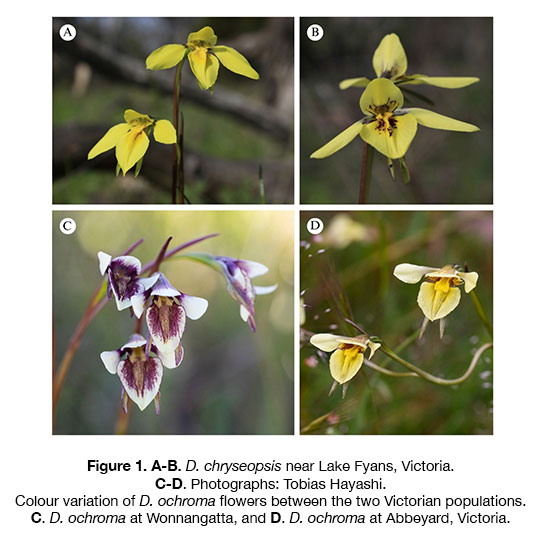
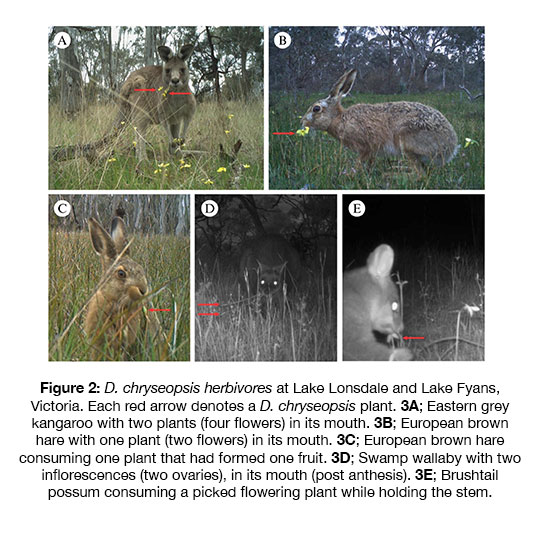
For D. chryseopsis we identified the breeding system, seed viability, pollinators, pollination strategy, and herbivores, and investigate conspecific density effects on fruit production and florivory. We found that D. chryseopsis is self-compatible but reliant on pollinators for sexual reproduction. Cross-pollination resulted in significantly higher seed viability than self-pollination, from which we recommend hand cross-pollinations to increase seed viability for seed collection. We found that D. chryseopsis flowers are nectarless but are pollinated by several species of food-foraging bee, indicating a generalist food-deceptive pollination system. Pollinating bees were predominantly Lasioglossum (Chilalictus) species. Video footage revealed five vertebrate herbivore species consuming D. chryseopsis (Figure 2), of which eastern grey kangaroos (Macropus giganteus) were responsible for 41 % of 105 recorded grazing events, followed by introduced brown hares (Lepus capensis; 34 %). No significant effect of conspecific density on plant pollination or florivory in 180, 2 × 2 m quadrats was identified. However, florivory was extensive, with ~ 48 % of 4,002 tagged flowers grazed. These results demonstrate that identification and quantification of biotic interactions is critical for effective management and suggest that florivory by native and introduced herbivores may be a significant threat to other terrestrial orchids in the grassy ecosystems of southeastern Australia.
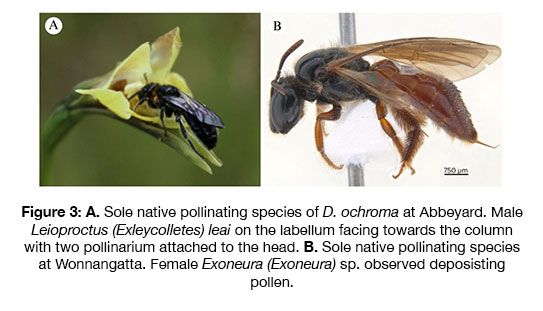
For D. ochroma we identified the pollinators, pollination strategy, extent of florivory, and microsite conditions associated with the presence of adult plants. Across Victoria’s two morphologically divergent populations, D. ochroma was pollinated by a different native bee at each study population – Exoneura (Exoneura) sp. (Apidae) and Leioproctus (Exleycolletes) leai (Colletidae). A generalist food-deceptive pollination system is likely used to attract pollinators given that the nectarless, bilaterally symmetrical flowers of D. ochroma attract food-seeking bees but lack morphological similarity to other co-flowering cream- to yellow- coloured rewarding flowers. Florivory rates were high (~ 23 % of 568 tagged flowers were grazed in their entirety), and one instance of invertebrate grazing was observed by the native grasshopper Phaulacridium vittatum Sjöstedt (Acrididae). While vertebrates weren’t observed feeding on orchids, cattle frequently grazed within the population extent. To identify if microsite conditions affected orchid presence, we measured percentage cover variables within 440 10 × 10 cm microsites (where D. ochroma orchids where either absent or present across microsites). Using Generalised Additive Models, we found orchid presence was positively associated with cover of native graminoids, which was driven by the grass Themeda triandra Forssk (Poaceae). In contrast, orchid presence was negatively associated with cover of introduced graminoids in most models. Statistical significance was inconsistent across models when testing for relationships between orchid presence and cover of bare ground, organic litter, and introduced forbs, while no association was found with native forbs. Due to pollinator specificity and variability in floral colour between each population, D. ochroma translocation sites will require confirmation of the presence of the corresponding pollinator species. Where practicable, exclusion of potential herbivores (e.g., cows) is recommended for the duration of the flowering and fruiting season. Finally, native grasslands where microsites contain native graminoid cover should be targeted for translocations.
Papers from this research:
Acknowledgements:
Thank you to Dr Michael Batley for the identification of over 750 pollinator specimens, Dr Bjorn Bohman for running the GC-analysis on my nectar samples, and Dr Xia Li for advice and support on the statistical analysis.
This work was funded by several organisations and institutions, including the Australian Orchid Foundation (Project: 346/2022), Trust for Nature (Scholes Student Scholarship), La Trobe University (Postgraduate Research Scholarship), the Australian Government (Research Training Program Scholarship), and DEECA (Preventing the extinction of Victoria’s threatened flora project – Nature Fund).