
<< BACK TO PROJECT LIST
Project: 365/2025
Title: The chemistry of pollination and herbivory defence in Cryptostylis (Orchidaceae)
Applicant: Saskia ter Horst
Institution: University of Western Australia, Perth WA 6009 and the University of Amsterdam, 1000BE Amsterdam, The Netherlands
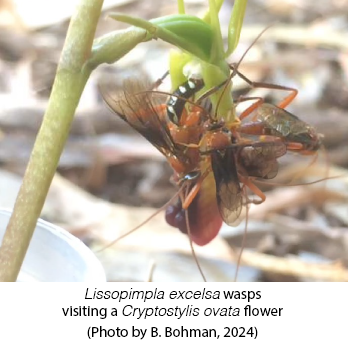
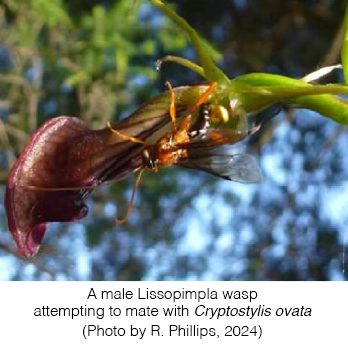
Recently, the first evidence for pro-pheromone mimicry was uncovered in the Australian orchid Cryptostylis ovata, which deceives male Lissopimpla excelsa wasps into pollinating it.
This theory suggests that the orchid flower produces pro-pheromones: precursor molecules (long-chain alkenes) that react with oxygen under the influence of UV radiation and heat. Only after exposure to the elements the alkanes break down into more biologically active aldehydes, which mimic the pheromones of female wasps and attract male pollinators.
While pro-pheromones have previously been found in some insect communication systems, this is the first known case of plants mimicking this mechanism. The dependence on environmental factors, such as UV and heat, might render this system highly sensitive to environmental and climate change. This project seeks to find additional evidence to confirm the pro-pheromone mimicry hypothesis in Cryptostylis ovata and explore whether strategy is also used in other sexually deceptive orchid species, such as Caladenia Barbarossa.
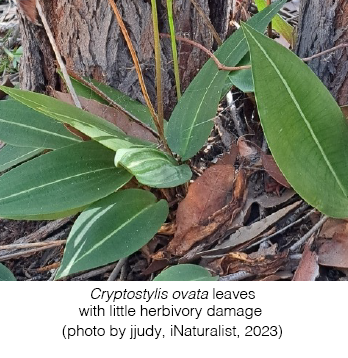
In addition, field observations suggest that Cryptostylis ovata leaves are scarcely damaged by herbivores such as caterpillars and kangaroos, unlike leaves of other orchids. A possible explanation is that alkaloids produced by Cryptostylis, called Cryptostylines, are toxic or detrimental towards herbivores. This project aims to verify these observations by comparing herbivory damage in Cryptostylis ovata to co-occurring species and to identify the structure of Cryptostylines.
Project outcomes:
This project focused on pro-pheromone mimicry: the hypothesis that long-chain alkenes produced by the plant oxidatively cleave into bioactive aldehydes, which attract pollinators. Evidence of this mechanism has previously been found in the sexually deceptive orchid Cryptostylis ovata. The project had three aims:
1. Further test the pro-pheromone mimicry hypothesis in Cryptostylis ovata;
2. Investigate whether Caladenia barbarossa employs similar pro-pheromone mimicry mechanisms;
3. Identify the structure and potential function of cryptostyline alkaloids in Australian species of Cryptostylis.
The results from this project further support pro-pheromone mimicry in C. ovata. In particular, (8Z)-tricosene and its potential breakdown products octanal and pentadecanal appeared to play a key role in pollinator attraction. Pollinator baiting experiments were done using synthetic compounds, and confirmed that octanal and pentadecanal combined with (S)-2-(tetrahydrofuran-2-yl)acetic acid attracted male Lissopimpla excelsa pollinators. Furthermore, (8Z)-tricosene was present in relatively high amounts in extracts of fully developed Cryptostylis flowers, but not in extracts from buds or wilted flowers.
In contrast, no evidence for pro-pheromone mimicry was found in C. barbarossa. Although this species was found to similarly produce a long-chain alkene, (7Z)-pentacosene, this compound or its cleavage products did not increase attraction of male pollinators in bioassays. However, two distinct new-to-science drakolide compounds were identified and found to be responsible for thynnine wasp attraction in this species.
Lastly, this study isolated three new cryptostyline compounds from C. ovata leaf extracts. The structure from one of these new natural products was determined using Nuclear Magnetic Resonance. Extracts of eastern Cryptostylis species were assessed as well, and the composition of cryptostylines seemed to differ between species. The exact function and biosynthetic origin of these compounds in the plant remains unknown.