<< BACK TO PROJECT LIST
Project: 370/2026
Title: The chemistry of pollination of Western Australian Pterostylis
Applicant: Nicholas Wildy
Institution: University of Western Australia (UWA), School of Molecular Sciences.
Perth WA 6009
Project Outline:
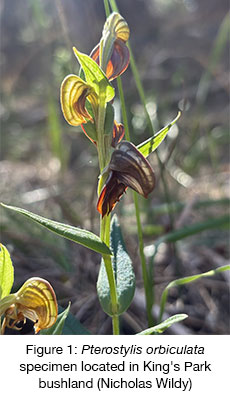
Australian greenhood orchids (Pterostylis) are among the country’s most diverse orchid groups, with more than 200 species occurring across Australia. Many of these orchids rely on sexual deception to attract their pollinators, producing chemical signals that mimic the sex pheromones of female fungus gnats (Diptera). Male gnats are deceived into attempting to mate with the flower, inadvertently transferring pollen between plants.
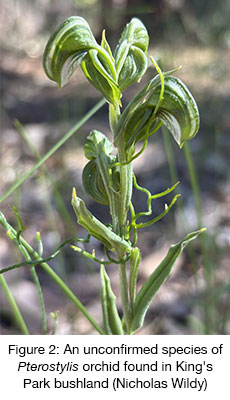
Despite the remarkable diversity of Pterostylis, very little is known about the chemical compounds responsible for attracting their pollinators. Recent research on Pterostylis orbiculata identified an unusual long-chain hydrocarbon as a key pollinator attractant and identified several candidate floral hydrocarbons in P. concava and P. vittata. This project will build on this work by undertaking more detailed chemical analyses of these species to identify and confirm the structures of their pollinator attractants. By synthesising these compounds and testing synthetic blends in field bioassays, I hope to identify additional structurally related long-chain alkene attractants across the genus.
Alongside this work, the recent discovery of pro-pheromone mimicry in Cryptostylis ovata has provided an opportunity to reassess the mechanism of pollinator attraction within Pterostylis. Given the low volatility of the previously identified long-chain alkene attractants in P. orbiculata, it is possible that these compounds function as pro-pheromone mimics, undergoing oxidative cleavage in the presence of oxygen and UV radiation to generate smaller, more volatile aldehydes. This project will test this hypothesis by synthesising these candidate aldehydes and comparing their attractiveness to pollinating fungus gnats with that of the previously identified alkene compounds. If supported, these findings would suggest that pro-pheromone mimicry is more widespread within the Orchidaceae than previously recognised, providing new insights into the evolution of chemical communication between orchids and their pollinators.
By improving our understanding of the chemical signals that underpin pollination in these remarkable orchids, this research will advance our knowledge of orchid evolution, pollinator specificity and the conservation of Australia’s unique orchid flora.